DPhil Student Alfred Lo Awarded First Place in Essay Competition Organised by the Korean Embassy in the UK
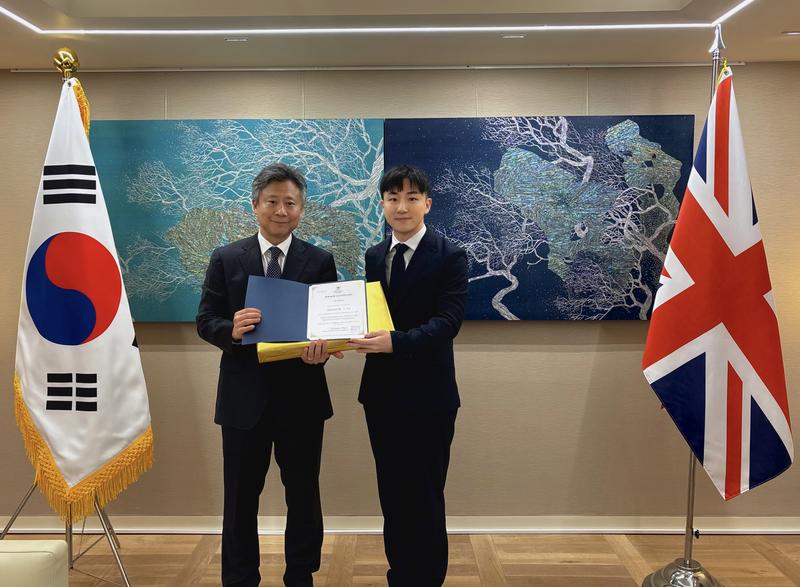
Alfred W. T. Lo, a third-year DPhil candidate at the Faculty of Asian and Middle Eastern Studies, has been awarded First Place in the Development of Korea-UK Relations Essay Competition, organised by the Embassy of the Republic of Korea in the UK. The competition invites submissions from undergraduate and postgraduate students across the UK and recognises only three awardees. Alfred’s work was selected for the highest honour following a rigorous and highly competitive review process.
Alfred was formally invited to the Korean Embassy in London on 21 November for the awards ceremony, where he received the award from the Chargé d’affaires of the Republic of Korea. During the visit, he also met members of the Public Diplomacy Team to engage in substantive discussions concerning Korea’s cultural presence, diplomatic priorities and areas of future cooperation between Korea and the UK. The award reflects his academic distinction and the real-world relevance of his contribution to scholarship on Korea and international cultural relations, supported by his expertise in linguistics and education.
Alfred’s essay, titled ‘Learning “K-” in UK: Reimagining Language Education through Korea-UK Partnership from a Trans Perspective’, investigates the rapid rise of interest in learning Korean in the UK, largely influenced by the global spread of Korean popular culture, or the Korean Wave. It considers how this development offers new possibilities for language learning in the UK, where participation in modern foreign languages (MFL) has been steadily declining. The essay presents a detailed analysis of how the ‘K-’ wave encourages British learners to participate voluntarily in linguistic and cultural practices beyond formal education, and argues that this trend offers a timely opportunity to rethink MFL education. It proposes a cooperative model that combines flexibility in cultural participation with a solid grounding in Korea’s historical, social and cultural contexts, supporting more meaningful intercultural understanding and stronger long-term cooperation between Korea and the UK.
Commenting on his work, Alfred said:
‘I believe the growth of interest in the Korean Wave across the UK demonstrates how cultural engagement can inspire new enthusiasm for language learning at a time when participation in modern foreign languages remains low. This development invites us to rethink how language education is shaped in the UK. I hope that cooperation between Korea and the UK will not only strengthen mutual understanding but also contribute positively to the wider global challenge of declining enrolment in modern language learning. I am truly grateful to the Faculty and to Korean Studies for nurturing me and for providing the academic environment that have enabled me to develop this work.’
Read more about the announcement via the Korean Embassy in the UK.

